
Maynard has declared a Nonessential Outdoor Water Ban, effective immediately. The ban was posted on the town’s website May 26 after the Executive Office of Energy and Environmental Affairs Secretary Rebecca Tepper declared a Level 3 Critical Drought for the Northeast. Maynard is part of the Northeast Drought Management Region established by the state.
The current drought began last August but follows years of below-average rainfall. Parts of this region received only 0.5 to 1.5 inches of rain during the first two weeks of May, half the usual average. The state uses rainfall data and 16 water gauges in streams across the region to monitor water levels. Those gauges showed that rivers and streams are lower than nearly all recorded values for this time of year.
“During drought conditions, low flows cause decreased river health and increased habitat stress because high flows help with diluting pollutants that enter water bodies,” said Abby McCarthy, Water Quality Program Manager at OARS, the local nonprofit watershed organization. “Drought conditions persist because a rain event is not enough to end a drought. In particular, the groundwater needs more water to recharge.”
Ingeborg Hegeman, OARS Interim Executive Director, added that “when a well pumps water from an aquifer, it reduces the hydraulic head in the surrounding area, causing water to flow toward the well. This creates a cone-shaped depression in the water table called the ‘zone of influence.’ Sometimes zones of influence may overlap, resulting in wells competing for water. Zones of influence may also overlap with streams, wetlands, and rivers, resulting in reduced surface water elevations.
“Reduced water levels have the potential to negatively affect wetland and water-dependent ecosystems,” Hegeman said. “Additionally, loss of soil moisture will affect agricultural activities, and wildlife in general will find it more difficult to seek out water. Another impact associated with drought conditions is loss of oxygen in riverine habitats. As water levels drop, the water becomes warmer, flow rates drop, and biological activity increases, all resulting in loss of oxygen and ultimately, fish kills.”
The town is required to follow Commonwealth requirements because the state permits Maynard’s public water supply. The town is drilling new wells to increase supply and is working to improve water quality, including new filters for PFAS. Even with the wells drilled, it takes three to five years for water to reach the pipes due to testing and permitting requirements, according to the town’s Department of Public Works.
The town is particularly concerned about irrigation systems running automatically and is sending letters to homes and businesses requiring compliance or warning of fines.
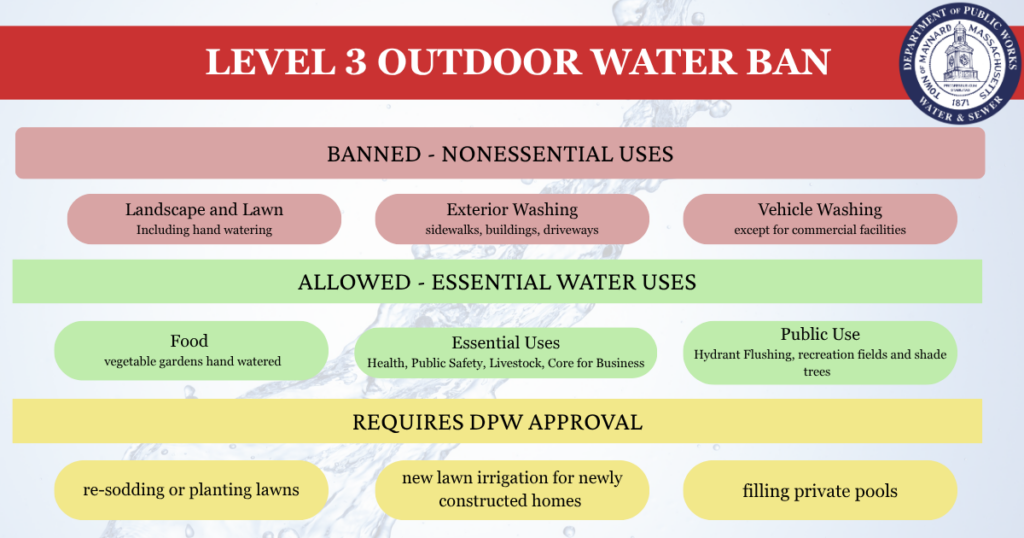
What does a Level 3 ban on nonessential outdoor water uses mean?
No uses that are not required for health or safety reasons.
- No irrigation of lawns via sprinklers or automatic irrigation systems (unless to establish new lawns, which requires approval)
- No washing of vehicles except by means of a commercial car wash, except as necessary for operator safety
- No washing of exterior building surfaces, parking lots, driveways, or sidewalks, except as necessary to apply paint, preservatives, stucco, pavement, or cement
- No filling swimming pools (requires approval)
- No irrigation to establish a new lawn during May or September (requires approval)
- No watering of lawns, gardens, or flowers, even by hand
What is allowed during a Level 3 ban?
- Water required for public health and safety
- Core business functions
- Maintenance of livestock
- Hand-watering of crops and food
- Irrigation of recreational fields
Practical suggestions for water conservation
The town has a list of frequently asked questions addressing the drought. Additional tips: Use the dishwasher instead of hand-washing when possible, run only full loads, skip pre-rinsing, and use the normal, sensor, or eco cycle rather than a quick-wash cycle. A normal cycle typically uses less water and energy than a quick wash. Commercial car washes tend to use less water because most use reclamation systems to recycle water. Residents can ask local car washes before choosing one.
Check toilets for silent leaks by putting a few drops of food coloring in the tank and waiting 10 minutes without flushing. If color appears in the bowl, there is a leak. Check outdoor spigots, hoses, and irrigation connections, even if irrigation is currently off. Look at your water bill for unexplained increases. Keep a pitcher of drinking water in the refrigerator instead of running the tap. Thaw frozen food in the refrigerator overnight instead of under running water. If washing dishes by hand, plug the sink or use a basin instead of letting water run.
Suggestions from Demetra Tseckares, a Maynard-based landscaping professional and owner of Gardens by Demetra.
- Let the lawn go dormant. A healthy lawn will survive and recover once conditions improve.
- Vegetables are a watering priority even during restrictions.
- Fall is a better time to plant if you are doing it yourself. New plants require close attention and more water to establish.
- Climate change is producing more intense storm events, and most water systems are not designed to handle them. Redirect as much rainwater as possible back onto your property rather than letting it run off.
- Aim downspouts into gardens. Use rain barrels, rain gardens, or dry wells.
Read the state’s press release on the drought here.
View and download the full State Drought Management Plan.


Leave a Reply