
Rockland Wells and Treatment Plant upgrades. Progress on Phase 2 of the Water Master Plan
Stay informed on local town priorities, challenges, successful investments, and more…
The Maynard Voice has been providing periodic updates on the town’s approach to investing in water resource infrastructure to increase delivery capacity and improve treatment. This Master Plan evaluates various supply alternatives, ultimately making a recommendation for a long-term water supply alternative considering several factors. The recommended water supply alternative is used as a baseline to develop a roadmap for upgrading the Town’s water treatment and supply infrastructure over the 50-year planning period. This Master Plan is meant to be paired with the forthcoming MetroWest MWRA Feasibility Study that will develop the cost of supplying water to MetroWest communities. Water Master Plan of Maynard
Phase 2 of the Master plan: Three new Rockland Ave Test Wells
This past month there has been a very visible step taken on this forward-looking and detailed plan to support redundancy, capacity and quality of the water resource. Three test wells were dug in the Rockland Avenue Conservation area at the north of town. The well field is just southwest of Route 27 near the Acton and Stow town lines and adjacent to the Rockland Avenue soccer fields.
The wells in this area are fractured bedrock deep wells and have the potential to provide somewhat cleaner and reliable (drought resistant) water than other shallow wells in the south of town.
Next up, the town will begin significant capacity and quality testing with Mass DEP using funds approved in Article 19 at our recent Town meeting. These funds become available on July 1.
Initially, the DPW with Mass DEP will run a 5-day full capacity flow test to gauge each well’s suitability for long term use. Then continued monitoring will be checking for seasonal variation in hundreds of both known and emergent contaminants to support needed water treatment plant upgrades to deliver high quality water far into the future. If successful, one, two or all of these treated sources may be brought online in the next three to five years. While more phases must follow to address the future economic growth needed to sustain the town long-term, this Phase two is prioritized to take the most responsible, consequential and realistic mid-term step in the town’s long-range plan.
For some background on why Phase 2 is the next priority, here are some comparisons of our town well fields in the form of Q&A.
Q1. How do these Rockland Avenue bedrock wells differ from the shallower sand wells in the Old Marlboro Rd (OMR) well field and well 8 behind Fowler School?
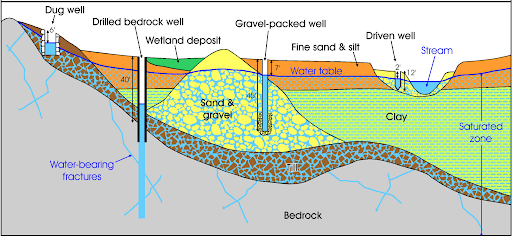
A1. Vulnerability to Contamination
- Fractured Bedrock Well: Generally more protected from surface contaminants because of the thick layers of soil and rock overlying the fracture zones. However, in areas with thin soil, pollutants can travel rapidly through near-vertical fractures. [1]
- Shallow Sand Well: Because they are unconfined and sit at the surface, shallow sand and gravel aquifers are highly susceptible to contamination from surface activities, septic systems, and agricultural runoff. [ 5]
A2. Water Quality & Treatment
- Fractured Bedrock: Water quality heavily depends on the mineral composition of the rock. Bedrock wells commonly require treatment for naturally occurring minerals like arsenic, iron, manganese, or radon. (and more recently PFAS and other emergent chemical contaminants) see more here: https://www.mass.gov/info-details/emerging-contaminants
- Shallow Sand: Water tends to be softer but may pick up sediment or require filtration for organic material and localized contaminants. [ 3,]
A3. Drought Susceptibility
- Fractured Bedrock: More resistant to short-term, seasonal droughts because deep bedrock aquifers contain a massive regional buffer.
- Shallow Sand: Water levels in shallow sand deposits drop rapidly during dry spells because the aquifer depends on continuous, immediate precipitation recharge. (Note: See this month’s Maynard Voice article on class 3 Nonessential Outdoor Water Ban)
For comprehensive guidelines on aquifer properties and testing, you can explore the U.S. Geological Survey Aquifers and Groundwater Guide or read the Water Well Journal Aquifer Types. [1]
Q2. Where are the 3 new fractured bedrock test wells located? Phase 2 of the Master plan is now underway:
A4. Verdantas https://www.verdantas.com/about/ , a consulting engineering company. produced an…analysis to determine if there were viable locations for new wells at the Rockland Avenue site. Three areas were identified (See maps below):
- TGP-1) Between the parcels of 4 Rockland Avenue and 10 Rockland Avenue, south of the Avenue within the Rockland woods conservation area.
- Rock Well #1-A) North of Rockland Avenue adjacent to the northwest edge of the soccer fields. This is near the site of the failed Well #1
- TGP-3) north of Rockland Avenue near the WTP and Well No. 6 (unused).
New wells could be useful in providing mechanical redundancy but will still be constrained by the overall capacity of the aquifer. New test wells will be pump tested and their viable yield will be determined in conjunction with assessing their influence on the production of other wells in the vicinity. A preliminary hydrogeologic evaluation estimates a total of 0.5 MGD in redundant well capacity might be found at this site through one or more new well sources; however, the capacity of this aquifer is likely close to the permitted limit.
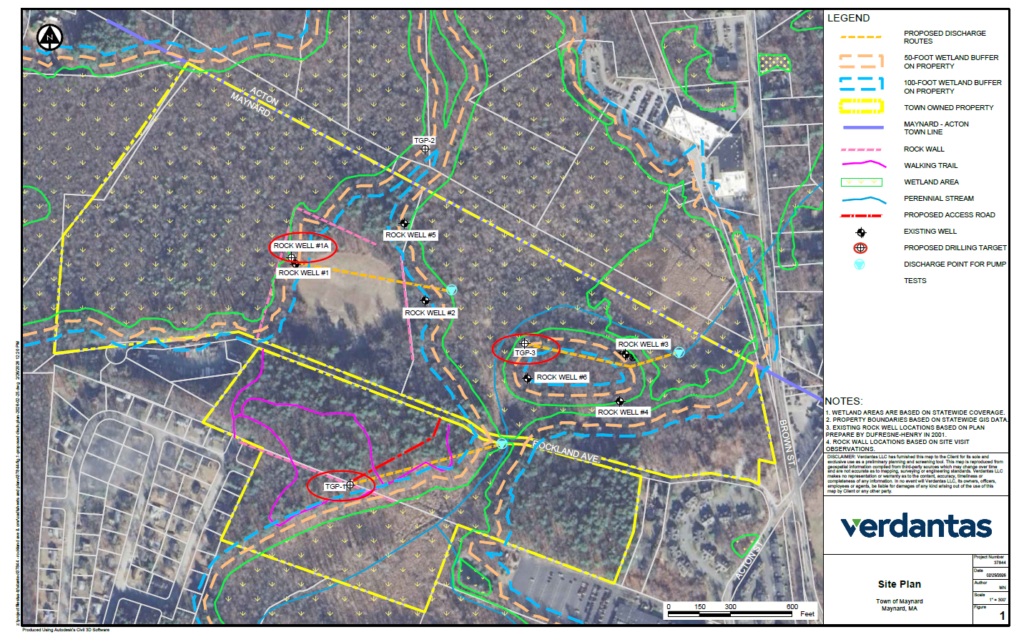
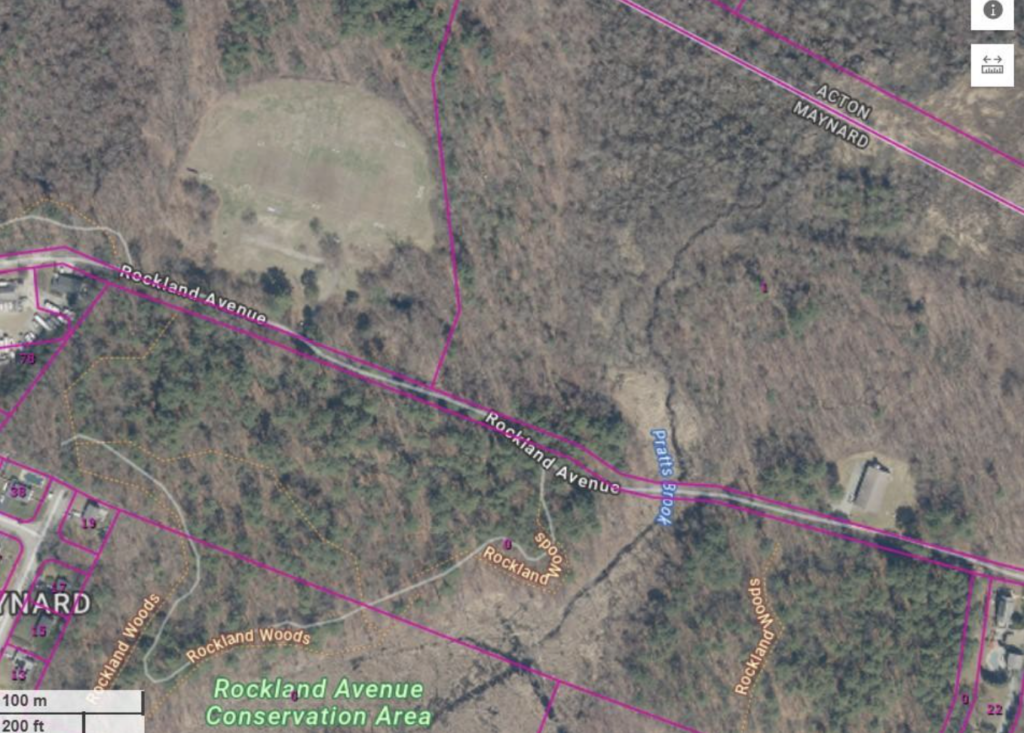
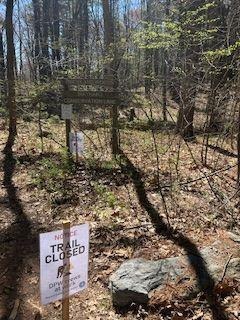
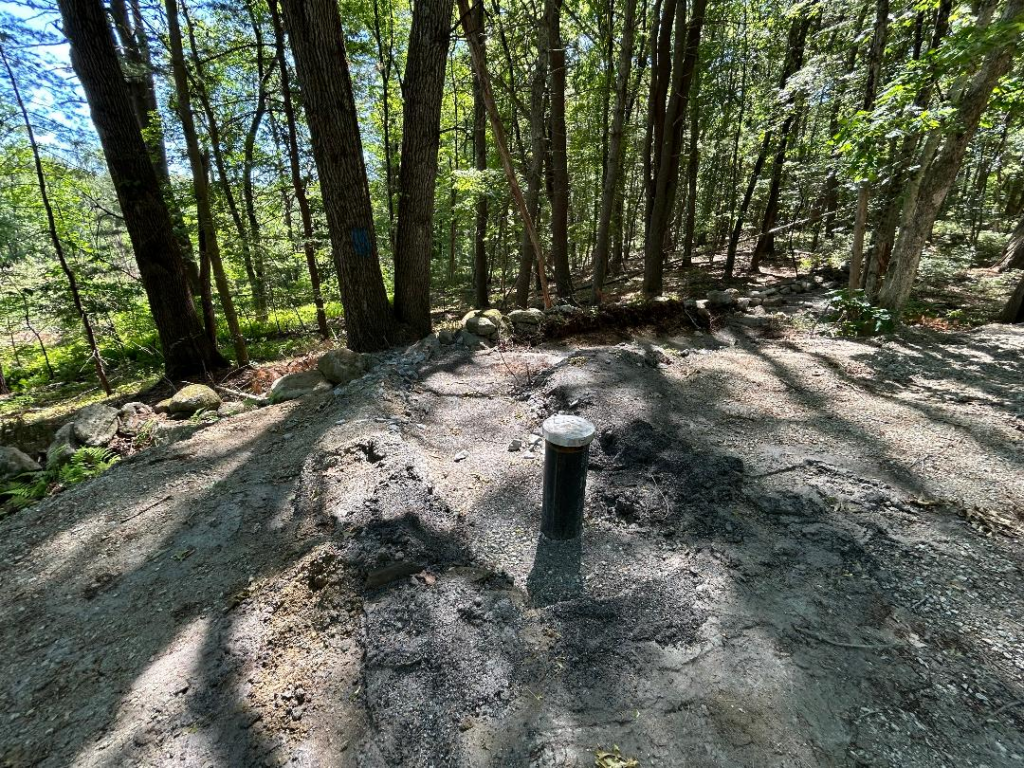
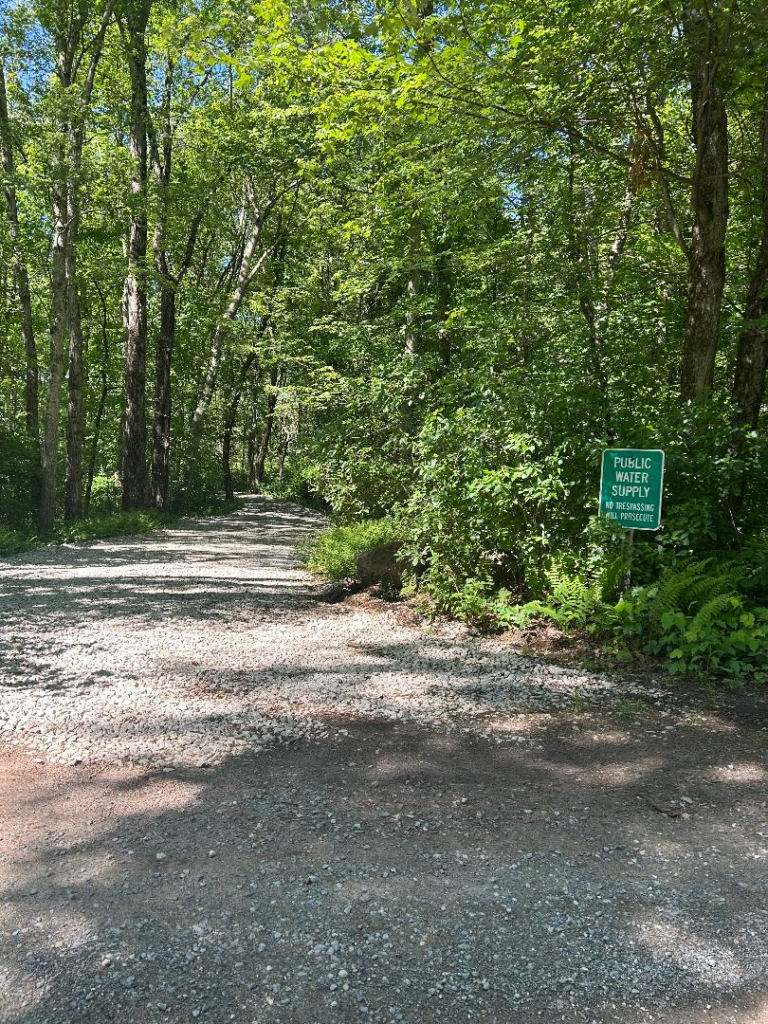
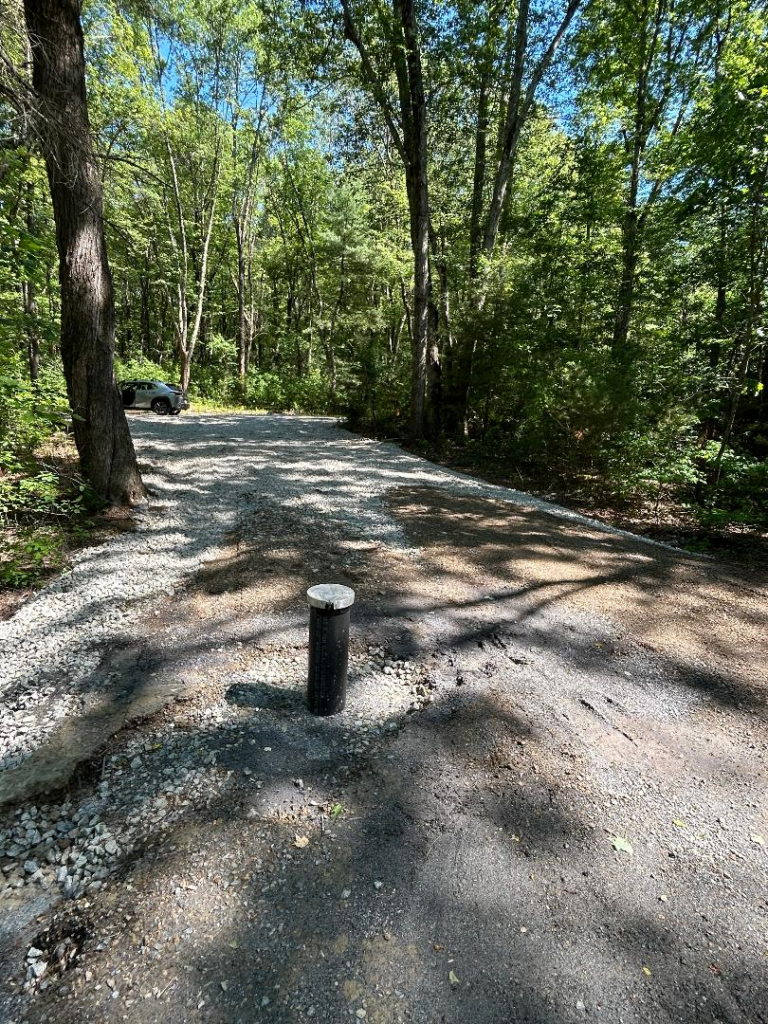
Images of work begun in the Rockland Ave area for Phase 2. As an example, in top 2 photos a nature trail has been temporarily closed and a gravel road created to access Test Well TGP-1 as shown in the lower left on the Verdantas map and circled in red.
In the lower 2 photos see the new gravel road to Test Well TGP-3 circled in red on the map, just beyond the WTP (water treatment plant) building shown on the right of the top satellite image.
A brief word on the continued investment in our Water Resource:
Excerpt from the DPW memo to the Select Board on February 26, 2026 and presented public hearing on water rates on March 17, 2026:
Proper long term financial planning in conjunction with precise capital improvement planning strategically addressing our aging and degrading conditions within our water & sewer utility infrastructure has allowed our financial model to handle and reduce the impact…and reducing the potential drastic impact to our use rates…Services such as water & sewer utilities should be financially stable, allowing the department to produce a consistent and reliable utility. Our current utility lacks the water production capability to support economic growth opportunities throughout the community.
Excerpt from memo on long range proposals:
Maynard’s Department of Public works, and eight (8) surrounding communities executed an intermunicipal agreement in 2025 to engage in a localized regional financial feasibility study to determine whether the Town and the interested communities will pursue admission, as a new community, to the Massachusetts Water Resources Authority (MWRA) water system which would facilitate a permanent connection to this system as another water source for Maynard. https://www.mwra.com/projects-programs/major-programs/water-wastewater-system-expansion
Sources: https://go.boarddocs.com/ma/tom/Board.nsf/Public Town Website, Bob McCarthy and Julia Flanary, Environmental Compliance and Data Manager for The Town of Maynard
Leave a Reply