
The Maynard Voice previously covered the town’s ongoing update to its Housing Production Plan (HPP) ahead of the first public forum on the plan, held July 29. That forum has now taken place, and planning consultants from CommunityScale presented initial housing needs data, demographic trends and a proposed production goal of 391 new units over the next five years, while acknowledging that water capacity constraints remain the town’s biggest obstacle to building.
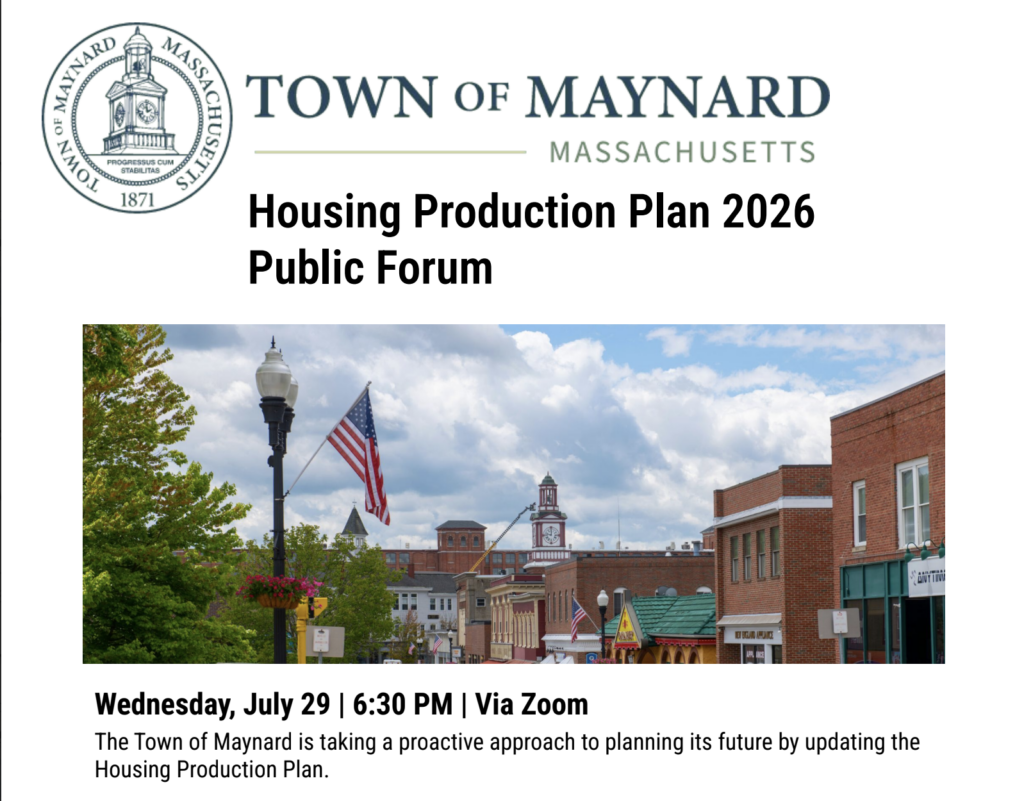
The virtual forum, hosted by Maynard Planning Director Bill Nemser and Office of Municipal Services staff, drew roughly 20 residents. CommunityScale, a Cambridge-based urban planning firm, is leading the update on behalf of the town’s HPP Advisory Group. Sarabrent McCoy, an associate with the firm, presented most of the findings, along with input from Nels Nelson, a principal at CommunityScale.
Where Maynard Stands on Safe Harbor
Background on the HPP process and Chapter 40B is covered in our earlier article; this piece focuses on what was presented and discussed at the July 29 forum itself.
McCoy told attendees that Maynard has currently achieved Safe Harbor status, meaning the town’s subsidized housing inventory (SHI), the state’s count of qualifying affordable units, has crossed the 10% threshold of the town’s total housing stock, as measured by the decennial census. Because that total is still based on 2020 census figures, the plan will need to account for anticipated 2030 figures to remain relevant through 2031, the end of this HPP’s five-year planning horizon.
Housing Needs Assessment Findings
McCoy presented several data points from the draft housing needs assessment:
- The 2026 HUD area median income (AMI) for the Boston-Cambridge-Newton region, which includes Maynard, is $165,000 a year. Maynard’s local median household income is lower, at roughly $131,000, or about 80% of the regional AMI.
- The typical home price in Maynard is approximately $616,000. Until around 2022, that typical home price was affordable to a household earning Maynard’s median income; it no longer is.
- Maynard has 4,558 households, roughly two-thirds of which have incomes below the regional AMI.
- The town has added about 44 households per year since 2010, even as its overall population has remained relatively stable, a trend McCoy attributed in part to shrinking average household size, now about 2.3 people, the lowest among the peer communities used for comparison.
- Nearly one in three Maynard households consists of a single person living alone, and roughly one in 10 households is a senior living alone.
- About one in three Maynard households is cost-burdened, meaning they spend more than 30% of monthly income on housing costs, including mortgage, insurance and utilities.
- Maynard’s owner-occupied vacancy rate is estimated at 0%, based on 2024 American Community Survey data, below the minimum stable target of about 1.5%.
- Maynard’s median age is about 45, among the highest of the peer communities used for comparison, which included Sudbury, Lancaster, Littleton, Stow, Bedford, Concord, Acton, Boxborough, Hudson and Clinton. The town also has the smallest share of children as a percentage of total population among those peers.
Based on this data, CommunityScale calculated that Maynard would need 391 new housing units over the next five years to keep pace with expected household growth, replace lost housing stock and bring ownership and rental vacancy rates up to healthy levels.
Water Capacity Remains the Central Obstacle
McCoy and town staff were direct in acknowledging that Maynard’s water capacity limitations mean the town cannot currently support the level of housing production the needs assessment identifies. McCoy said the plan will lay out multiple pathways depending on how the water situation develops, and will be framed in part as an advocacy tool documenting the town’s housing needs and its efforts to address them despite existing constraints.
Town staff added that the HPP plays a practical role in a broader package of materials the town submits periodically to the state as part of an effort to earn a Housing Choice Community designation, which can make the town eligible for infrastructure grant funding.
Several residents asked how the plan might help resolve water issues directly. Town staff responded that state funding secured through Maynard’s legislative delegation has focused on water treatment and quality rather than overall system capacity, and that a DPW representative was not present at the forum to speak to capacity-specific funding questions in detail.
Other Discussion Points
- Like-for-like conversions: McCoy described this as a strategy under consideration in which existing buildings with larger units, such as three-bedroom apartments, could be reconfigured into a greater number of smaller units without increasing the building’s water demand or footprint.
- Accessory dwelling units (ADUs): Town staff said the town has seen a sizable increase in ADU building permit applications since adopting its ADU bylaw, including new construction on smaller lots, following the state’s 2024 change making ADUs a by-right use. Staff said it remains too early to assess outcomes since few, if any, ADU projects have been completed to date.
- Development sites: Staff confirmed that a previously proposed 40B development off Route 27 near Market Basket has been withdrawn, and that the town’s Conservation Division has expressed interest in preserving some or all of that parcel due to wetlands and its proximity to the town’s water supply and treatment facility on Old Marlboro Road. Separately, the Stratus campus site at 111 Powder Mill Road has been zoned under the MBTA Communities overlay for by-right development of more than 400 units, though staff noted that site is also constrained by water supply limitations.
- Traffic: In response to questions about cumulative regional development along the Powder Mill corridor, staff said an ongoing multi-town study involving Maynard, Concord and Acton is examining car, pedestrian and bicycle traffic impacts along Route 62. Staff also noted the town is initiating a redesign of the Maynard portion of the Powder Mill Road right-of-way, a project expected to take several years in coordination with neighboring communities.
- Quality of life: Asked whether the housing production process accounts for quality-of-life impacts on existing neighborhoods, town staff and McCoy said the HPP is fundamentally shaped by the needs of current residents, including housing type and affordability, and that new development proposals are subject to review processes, including traffic studies for larger projects, that consider community impact.
What’s Next
CommunityScale plans to hold a second public forum in October focused on implementation strategies. A draft of the Housing Production Plan is expected to be presented to the Select Board in November, with submission to the state’s Executive Office of Housing and Livable Communities anticipated in December.
Resources
- Maynard Housing Production Plan Dashboard
- Affordable Housing Inventory – Maynard
- Questions about the HPP update can be directed to Planning Director Bill Nemser at [email protected]
Leave a Reply