
Editor’s note: Natalie Robert is a member of the Maynard Planning Board. She is not a member of the Housing Production Plan committee.
The town is updating its Housing Production Plan (HPP), a document that will help guide local housing policy over the next five years.
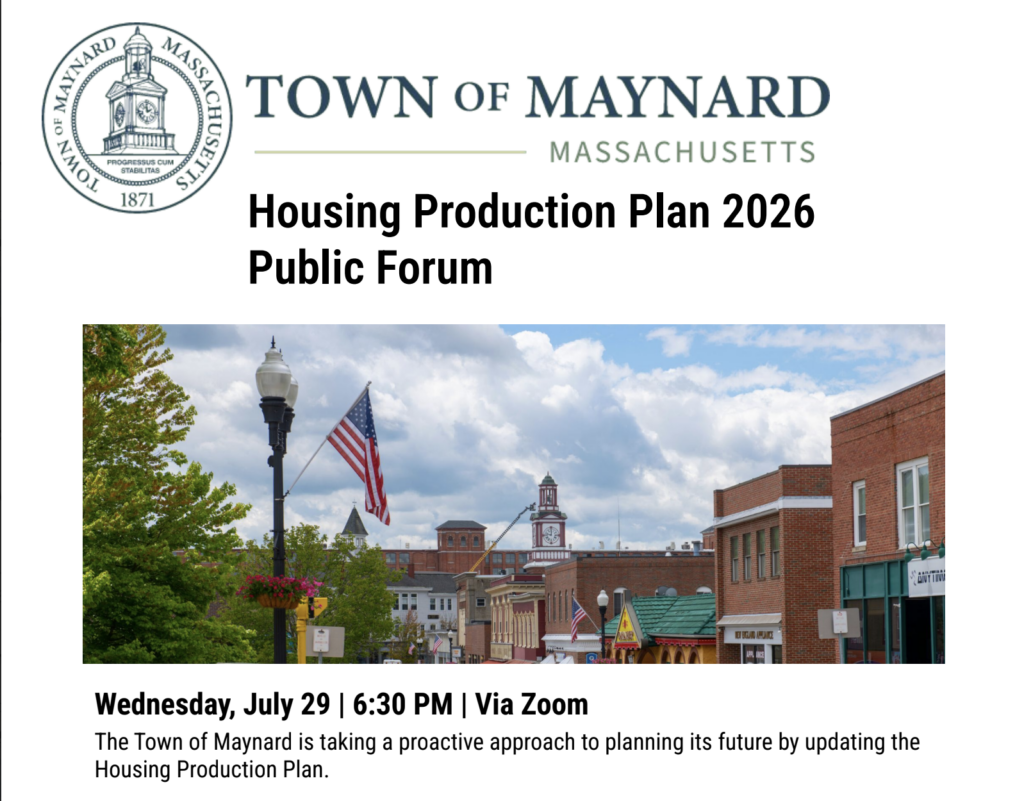
Residents will have opportunities to learn about the proposed plan, ask questions and offer feedback before it is finalized, and the first public forum is on July 29 on Zoom at 6:30 p.m. It is open to the public at no cost, but attendees must register in advance on Eventbrite.
The HPP committee hopes to hear from a wide cross-section of the community, because local input is important to developing a plan that reflects Maynard’s priorities and future needs.
One goal of the HPP is to understand if Maynard has the right mix of housing, not simply enough housing overall. Expanding the variety of housing types, including smaller homes, apartments and accessible units, can help address some of these gaps.
A Housing Production Plan is a planning document, not a development proposal. It doesn’t approve new housing projects or change zoning. Instead, it evaluates Maynard’s current housing stock, identifies future needs and recommends strategies the town can consider over the coming years.
A National and Statewide Housing Challenge
Housing affordability has become a national problem affecting communities of all sizes across the United States. In many regions, housing costs have grown faster than household incomes, leaving more renters and homeowners spending a significant share of their income on housing. A household is generally considered “housing cost-burdened” when it spends more than 30% of its income on housing costs, including rent/mortgage payments, utilities, insurance and other expenses.
Renters are often especially affected, but rising property taxes, insurance costs, maintenance expenses and mortgage payments can also create challenges for homeowners. Across the United States, many communities are also facing a shortage of available homes, especially homes that are affordable to first-time buyers, younger households, seniors looking to downsize and people seeking smaller or more accessible housing.
These challenges are reflected in Massachusetts, where high housing costs and limited housing supply have made it increasingly difficult for many residents to find homes that fit their needs. National discussions, including recent federal proposals such as the ROAD to Housing Act, focus on many of the same questions communities are considering locally: how to increase housing supply, improve affordability, expand opportunities for both homeownership and rental housing and address barriers that make it difficult to build new homes.
For communities like Maynard, the challenge is not simply building more housing. It is understanding what types of housing are needed, where they may fit, and how future housing decisions can align with local priorities, infrastructure capacity and the needs of current and future residents.
Housing in Maynard: More Than Affordability
Affordability is one of the biggest housing challenges facing Maynard, but it is only one part of the conversation. In Maynard, approximately 37% of renters are considered housing cost-burdened.
Maynard is a small community of approximately 10,700 residents living in about 4,800 households. The town’s housing stock is primarily made up of single-family homes, which account for roughly 60% of housing units. About 25% of households are renters, while 75% are homeowners.
Many of Maynard’s single-family homes were built before 1970. These single-family homes remain an important part of the town’s character, but they may not include features that meet the needs of today’s residents. As residents move through different stages of life, what they need in a home will change.
Some residents are looking for smaller homes that require less maintenance. Others need apartments or condominiums, accessible homes for people with mobility challenges or homes with energy-efficient features and construction. Young adults hoping to build their lives in town, seniors who want to downsize without leaving the community and Maynard’s local workforce may all be looking for housing options that are currently limited or, in some cases, unavailable entirely.
Why Does the Town Need a Housing Production Plan?
An updated Housing Production Plan helps Maynard qualify for state and local grants and funding opportunities by demonstrating that the town has carefully evaluated its housing needs and developed a strategy for addressing them. Those programs can support both housing initiatives and the infrastructure needed to accommodate future growth.
The plan can also strengthen the town’s position under Massachusetts housing law: Municipalities with a state-approved HPP that have shown measurable progress toward their housing goals may qualify for certain “safe harbor” protections when reviewing Chapter 40B affordable housing proposals.
According to the HPP committee, planning ahead for housing needs gives the town more options than responding to individual development proposals as they arise. The plan also provides a framework for long-term decision-making. Housing needs change over time, and having a plan allows the town to consider future challenges proactively.
Understanding Affordable Housing
The phrase “affordable housing” is often misunderstood because it has a specific legal definition in Massachusetts.
Most affordable housing programs serve households earning no more than 80% of the Area Median Income (AMI). For Maynard, those income limits are based on the larger Boston-Cambridge-Newton metropolitan area, which includes communities across eastern Massachusetts and southern New Hampshire. Because that regional grouping includes many higher-income communities, the income limits can seem higher than many people expect.
Affordable housing is only one part of the Housing Production Plan. The broader goal is to ensure that Maynard has housing choices for people with different incomes, household sizes and stages of life.
What Has Maynard Already Done?
The previous plan, adopted in 2021, identified rising housing costs and a limited diversity of housing as challenges. It recommended encouraging a wider range of housing types, including accessory dwelling units (ADUs), duplexes, triplexes, multifamily housing and mixed-use development, particularly in areas with existing infrastructure and services.
Since then, Maynard has taken several steps to diversify housing.
In 2024, Town Meeting approved a bylaw making it easier for homeowners to create ADUs, such as in-law apartments or backyard “tiny houses.” Shortly afterward, Massachusetts adopted a statewide ADU law as part of the Affordable Homes Act, allowing qualifying ADUs up to 900 square feet to be built by right in single-family zoning districts. The state law allows smaller housing units while still authorizing reasonable local regulations.
Maynard has also continued to refine its Inclusionary Zoning Bylaw, which requires affordable homes in certain new developments. Recently, the town has placed greater emphasis on homes affordable at 60% of the Area Median Income, helping ensure that new affordable housing serves residents with lower incomes who often face greater difficulty finding housing in the private market.
The town’s Affordable Housing Trust continues to support efforts to create and preserve affordable housing, while the Downtown and Powder Mill Overlay Districts encourage housing in areas that already have infrastructure, businesses and municipal services.
Housing and Infrastructure Needs
Questions about infrastructure are among the most common concerns residents raise when discussing housing: How will additional housing affect schools? Is there enough water capacity? What about traffic, sewer service or other municipal infrastructure?
These are central questions in the planning process. Water capacity, in particular, has been one of Maynard’s most significant constraints on development. Town staff, the Department of Public Works, the Select Board and other committees have been working to align future housing planning with investments in water capacity, utilities, transportation and other municipal infrastructure. The town has also worked with its state legislative delegation to get additional state funding and support for critical water infrastructure improvements.
Why Public Input Matters
The Housing Production Plan is being developed by a committee that includes residents, town staff, members of town boards and committees and planning professionals. While the plan is informed by housing data, demographic trends and state requirements, community participation remains an important part of the process.
Residents bring local knowledge that data alone can’t provide. They understand their neighborhoods, daily experiences and the opportunities and challenges they see for the town’s future. Whether someone’s primary concern is affordability, neighborhood character, infrastructure, environmental sustainability, economic development or helping residents remain in Maynard throughout different stages of life, those perspectives can help shape the final recommendations.
Communities do not remain static. Housing ages, populations change and state housing policies continue to evolve. The Housing Production Plan is an opportunity for Maynard to think carefully about those changes and decide how the town wants to prepare for the future.
The town will hold the first of two public forums on July 29 from 6:30 to 8:30 p.m. on Zoom with an interactive format and several ways for attendees to offer input and ideas.
Advance registration is required; register on Eventbrite. Questions about the current Housing Production Plan update can go to Planning Director Bill Nemser at [email protected].
Resources

Leave a Reply