
Editor’s Note: The following is an opinion piece submitted by Abbie Barrett of Green Maynard in support of the light pollution bylaw appearing on the May 18 Annual Town Meeting warrant. It represents the views of the author, not The Maynard Voice. The Voice welcomes responses and opposing viewpoints. Please post in the comments.
We often think of cities as the main culprit of light pollution. But in suburbs like Maynard, where roughly 2,500 stars should be visible under normal nighttime conditions, only a few hundred can be seen. Anyone who wanted to see the Northern Lights earlier this year knows how difficult it is to find dark skies in Maynard. (And those around for the Great Northeast Blackout in 2003 might remember the spectacular night sky.)
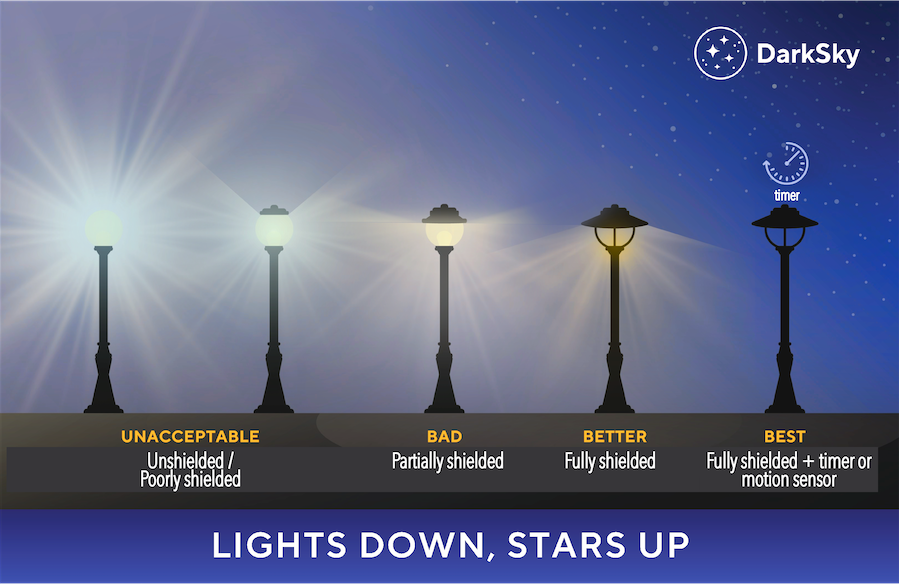
Much of our outdoor residential lighting is inefficient, poorly installed or unnecessary — wasting money and energy, harming wildlife, impacting human health, compromising safety and annoying our neighbors.
On May 18 at Town Meeting, residents will have a chance to vote for a bylaw to reduce light pollution in Maynard.* Simply put, the bylaw aims to ensure that outdoor lighting shines where it’s supposed to, illuminating its intended target and not everywhere else. This means curbing “uplight” — light that goes directly into the atmosphere — and more importantly, the “glare zone” — light that shines out horizontally (60–90 degrees). If you’ve ever walked past a bare floodlight over a garage or driven where streetlamps are not properly shielded, you’ll know how difficult it is to see in this zone. This light can travel for miles, spreading skyglow far beyond the property where it’s installed.
How much will the bylaw impact residents and businesses?
If you’re not adding or replacing light fixtures on your property, it doesn’t impact you at all. This bylaw only applies to lighting added or altered after the bylaw is passed.
If you’re adding or replacing a light fixture, the bylaw would require you to install fully shielded fixtures (or bulbs with lower lumens) and bulbs with a color temperature less than 2,200 Kelvin — meaning more amber in color and less white/blue.† Prices for fully shielded outdoor lighting are in the same range as non-shielded. Plus, the light is directed toward its intended target and not wasted shining into the sky (and your neighbors’ windows).
Why Have a Bylaw, Particularly If Stargazing Isn’t Your Thing?
Vote Yes for the Birds and Other Wildlife
Light pollution negatively affects all manner of animals — birds, mammals, fish, turtles and more — who are forced to shift their movements into shrinking areas of darkness, disrupting their hunting and mating cycles. Chronic glow also suppresses melatonin and alters their circadian rhythms, which in turn affects hormones tied to stress, metabolism, immune function and reproductive behavior. (It also impacts humans; more on that in a bit.)
Eighty percent of migrating birds do so at night, and many or most use the stars to navigate. Lights can throw birds off their migration paths, leading to fatal exhaustion or collision.
Billions of insects — a main source of food for birds and other wildlife — are drawn to outdoor lightbulbs each night, where they ultimately die from exhaustion as they endlessly circle. Artificial light also disrupts their reproductive, foraging and navigational behaviors (and some insects, like fireflies, depend on darkness to transmit signals for mating).
In addition, nocturnal insects like moths are important pollinators, with some studies showing they do as much pollinating as non-native honeybees. But gardens have 62% fewer visits by nocturnal pollinators in the presence of artificial light. This disruption in pollination affects plant reproduction, creating a cascading effect throughout food webs, including our own.
In October 2025, Maynard residents voted overwhelmingly to support a ban on anticoagulant rat poison to protect hawks, owls and other animals. This lighting bylaw adds another layer of protection for wildlife.
Vote Yes for Your Health
Artificial light also disrupts human circadian rhythm, the internal 24-hour clock that regulates our biological and behavioral cycles, including the production of melatonin. Lower melatonin can result in sleep deprivation, fatigue, headaches, stress, anxiety and other health problems. Research shows a connection between reduced melatonin levels and cancer, and the negative health effects of artificial light prompted the American Medical Association to support efforts to control light pollution. In particular, blue light — from phones, laptops and LEDs popular in industrial and city lighting — reduces levels of melatonin in humans. Higher exposure to light at night is also linked to increased risk of heart disease and stroke, as well as depression.
Vote Yes for Safety
This bylaw will not compromise safety. In fact, one of its goals is to make areas across Maynard more safe. Having a well-lit property is important to protect you from potential hazards, find your way and deter potential crime. But bigger and brighter does not equal safer. In fact, too much lighting can have the opposite effect. Outdoor lights that glare up and out create what is called “disability glare,” impairing vision — particularly for elderly individuals and those with cataracts — by creating harsh, unsafe shadows rather than illuminating the intended area. (You can learn more from lighting and safety expert Debbie Moran, who recently worked with law enforcement on a lighting bylaw in Houston.)
Vote Yes to Conserve Energy and Keep Maynard Beautiful
DarkSky estimates that at least 30% of all outdoor lighting in the U.S. is wasted, mostly by lights that aren’t shielded. That adds up to $3.3 billion and the release of 21 million tons of carbon dioxide per year. It would take 875 million trees annually to offset all that carbon dioxide.
Inside your home, you likely have lamps with shades or recessed lighting to hide the harsh glare of the bulb from direct view; it makes sense to apply this same approach to outdoor fixtures to protect Maynard’s dark skies, green spaces and wildlife — all part of what makes this town great.
Want to know more?
View this presentation from Dr. James Lowenthal, chair of the astronomy department at Smith College and president of DarkSky Mass, hosted at Maynard Public Library. Watch astronomer Kelly Beatty’s presentation “Darkness in Distress: Harmful Effects of Light Pollution,” originally presented in Newton. MA DarkSky and International DarkSky have plenty of useful information on their websites. Learn about the bylaw on greenmaynard.org/blog/lighting-bylaw.
*In drafting this bylaw, Green Maynard worked with experts from DarkSky Mass — part of the International Dark Sky community — and took note of similar bylaws in neighboring towns. Across the state, 75 municipalities have adopted some form of light pollution legislation, and there are two statewide proposals currently in committee.
†Amber light’s longer wavelength minimally disrupts melatonin and circadian rhythms — and attracts far fewer insects — while blue light’s shorter wavelength strongly suppresses melatonin, disorients nocturnal wildlife and draws insects in large numbers.


Leave a Reply