Editor’s Note: The following personal essay was submitted by Maynard Voice board member Mark Alston-Follansbee, writing as a private citizen and Vietnam veteran. It represents the views of the author, not The Maynard Voice or its board. The Voice welcomes responses and opposing viewpoints. Please post in the comments.
A Note From Mark: My wife Emily and I were recently on a Zen meditation retreat for veterans and their families. One of our practices was a writing exercise with the topic “What do I want civilians to know about my military service?” I’d like to share what I wrote.
During my PTSD disability hearing with a VA psychologist a few years ago, he said there are some people who can go to war and be OK, but that I wasn’t one of them. I wish they figured that out when I was drafted but they needed bodies and didn’t care when I told them that I had flat feet, terrible vision, and an apathy for violence.
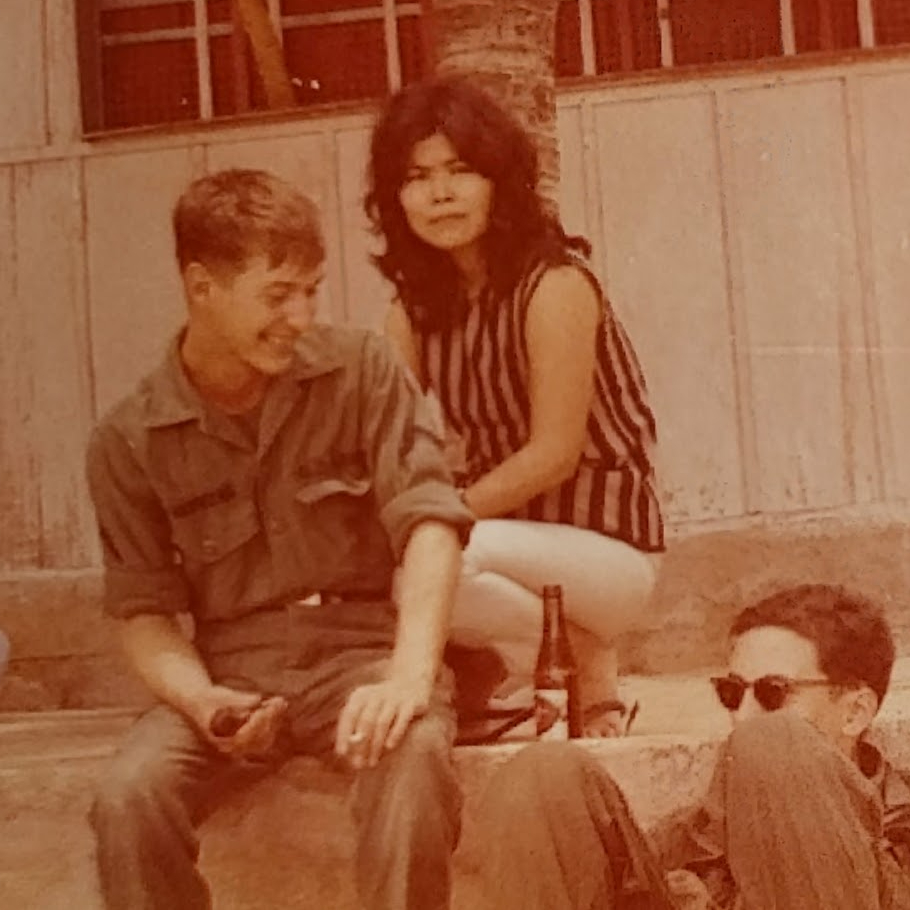
I remember when we landed on March 23,1967, in Cam Ranh Bay, every seat was taken with fresh ‘cannon fodder’ on this big, commercial plane. They opened the door and the blast of hot air took my breath away. I remember how wobbly my legs were trying to walk down the stairs to the tarmac. We stood in formation while assignments were given out. I was afraid, very afraid.
I quickly learned it wasn’t safe to feel fear because if I showed any fear I would be too vulnerable, too exposed as the fraud I was, pretending to be a soldier. While I had basic training in war, the reality was something I wasn’t prepared for. If they saw my fear – it could have been a person walking down the road, or even a child – they’d know I was an easy target and try to kill me.
But the result of hiding my fear was that I lost access to all my feelings – they all had to be stuffed way down so I didn’t have to feel my fear. And I stuffed those feelings so far down that I am still trying to connect with them, 58 years later.
I hated the Army: the structure, the rules, the discipline, the guns. I got kicked out of college after one year and the last thing I wanted was to put on a uniform. My father was on a submarine in the South China Sea during World War 2: they were trying to find pilots who had been shot down on bombing runs over Japan.
He was so traumatized that after four years at home he decided to become a minister, hoping God would save him.
He was revered in the community and an angry, out of control man at home; it was very confusing for a child. His only advice when I got drafted was that I “shouldn’t miss the experience of my generation.” He had thought he was in WW2 so his children wouldn’t have to go to war. I never forgave him for that advice.
So I got drafted and was then told I could do whatever I wanted for my military service job if I enlisted for one more year. I knew I didn’t want to be an infantryman in Vietnam and I had planned on a career as a journalist, so I added that year of service. I was lucky in the sense that when they’d send me out in the field, I’d always be in the second wave. I’d write the story, and then go to the beach and get stoned.
I was told to write stories the way they wanted them written or I’d be sent to the field with a gun instead of a camera. After I got out I never wanted to write another story or take another photograph. On the first night of the Tet offensive, January 30, 1968, I was flying back into Tan Son Nhut and I could see the mortars popping behind the plane, trying to hit us. Why can’t I remember what happened next? I have no idea how I got off the plane and back to the base; it’s all shut down inside me.
I survived the year, but at what cost? I was nonverbal for months, afraid of any strange noise. I had no intimate relationships and took handfuls of LSD to find a place where I felt safe. Because of that added third year, I still had service time when I returned from Vietnam and I was stationed at the Army Intelligence School in Baltimore. I’d spend my weekends demonstrating in Washington against the war. One time I was arrested for sitting on the grass in a Baltimore park and my commanding officer had to come and bail me out. He sees me wearing Vietnamese black pajamas and throws his hands up in disgust. It was a schizophrenic time.
When I returned, I never talked about being in Vietnam; none of my friends knew my story. I stayed stoned and pretended to act like I was OK. In 1984 I had a nervous breakdown: a friend had made a documentary of refugees from Vietnam who had moved to the San Francisco Bay Area. Interspersed with their stories was film of the war: B-52s carpet bombing, people and villages burning, death and destruction. I freaked out and and hid under the covers in the fetal position. My girlfriend suggested that I needed therapy.
I landed in Massachusetts for all the wrong reasons in 1985. I got an apartment in Central Square, Cambridge and a job near Harvard Square and started talking to people on the street when they would ask for money. Turned out many were veterans, mostly from Vietnam. I got angry and started volunteering with the city and eventually was hired to work with the homeless. That’s where I met Emily: how fortunate, but also where my experience started to spill out.
I went to a conference on homeless veterans and someone from the Vet Center said, “Welcome Home.” I burst into tears. No one had ever said that to me before, and he offered support if I wanted to come to the center. I joined a support group and was struck by how all the rest of the guys had come home, started families, bought houses, got good jobs and after 20 years their PTSD was making a shambles of the life they had built.
Now I had a wife and two children and I was putting them through hell with my alcoholic drinking and anger. Not only had the war destroyed so many years of my life and my hoped-for career, but I was making their lives difficult too.
I never applied for disability compensation or wanted anything to do with the VA but after I retired from full-time work I began to realize how my work had been a crutch to keep me from those feelings and it made me really angry to realize all I had lost. Five years hiding out in the woods, unable to have intimate relationships, depressed and unfeeling. Staying stoned on any substance I could find so I didn’t have to feel anything. Why should I apply for disability compensation? I was a fraud, I never fired a weapon, never killed anyone. What did I deserve?
We all deserve to know the real costs of war. I know what the Vietnam war cost me. I am convinced violence is not the answer; it only sows more violence. But we continue to allow wars to continue in our name. We – you and me and every person in the United States – are now spending $1,000,000,000 a day – 1 billion dollars a day! – to kill people half way around the world.
Imagine what that 1 billion dollars a day could do here. There are 49 million people in this country who are food insecure, 20% of all our children! There are over 770,000 homeless people in the wealthiest country the world has ever known. Think they might have a different idea for that money? My Zen teacher, Claude Anshin Thomas, a Vietnam combat veteran, says “if we want the world to be different, we have to find peace with our unpeacefulness.” So I meditate in silence seeking peace in me and in our world; and the feelings that were buried deep inside me are coming out.


Leave a Reply